

Most-played slots at Slotlounge Casino
Slotlounge Casino features a diverse selection of popular slots from leading developers. Players can enjoy high-RTP titles like Extra Juicy and Gates of Olympus (both 96.5%), alongside engaging Megaways games such as MONOPOLY Megaways that offer varied volatility and gameplay styles.

































What It's Really Like Playing at Slotlounge Casino
slotlounge Casino is an offshore online gaming platform that has attracted attention from Kiwi players searching for pokies, table games, and live dealer entertainment outside New Zealand's borders. This slotlounge review is written for New Zealand readers who want to understand how the site operates, what protections (or lack thereof) apply, and how it fits into the country's rapidly changing regulatory picture. As of 2026, New Zealand is rolling out its first-ever domestic licensing regime for online casino gaming, which makes it especially important to understand where operators like slotlounge Casino currently stand.
This guide does not promote slotlounge Casino, nor does it suggest that playing there is risk-free or guaranteed to be profitable. Instead, it aims to give an educational, balanced overview: what the platform offers, how offshore licensing actually works, what to check before depositing, and how the incoming Department of Internal Affairs (DIA) framework will change the landscape for New Zealand online casino gaming from December 2026 onwards.
Casino Overview
slotlounge Casino positions itself as a broad-spectrum online gaming site, offering pokies, table games, and live dealer options aimed at an international audience that includes New Zealand players. Like most offshore operators serving the NZ market, the platform is not physically based in New Zealand and does not hold any New Zealand gambling authorisation — a point that applies to virtually every online casino currently accessible to Kiwi players, since no such authorisation yet exists domestically.
The site's presentation follows a familiar pattern for modern iGaming platforms: a searchable pokies library, a promotions section, a cashier for deposits and withdrawals, and customer support channels. For New Zealand readers new to offshore gaming, it helps to understand that "offshore" simply means the operator is licensed and based outside New Zealand — a structural reality of the current market, not necessarily a red flag on its own, provided the operator holds a recognised foreign licence and demonstrates transparent terms.
Understanding slotlounge Casino, therefore, means looking past the marketing layer and examining the fundamentals: who licenses it, how fair its games are certified to be, how withdrawals are processed, and what recourse (if any) a New Zealand player has if something goes wrong. The sections below unpack each of these in turn.
Licensing & Safety
Licensing is the single most important factor for any Kiwi player evaluating an online casino, and it is also the area most likely to be misunderstood. Offshore operators typically hold licences from jurisdictions such as Malta (Malta Gaming Authority, MGA), Curaçao, or Kahnawake (Canada). These are legitimate regulatory bodies within their own frameworks, and they generally require operators to meet standards around game fairness, fund segregation, and dispute handling. However, it is essential to state plainly:
No New Zealand law recognises these licences as equivalent to a domestic one.
New Zealand's regulatory landscape is changing quickly. The Online Casino Gambling Act 2026 came into force on 1 May 2026, establishing the country's first legal framework for domestically licensed online casino gaming. Under this Act, the Department of Internal Affairs (DIA / Te Tari Taiwhenua) — New Zealand's gambling regulator — is responsible for allocating up to 15 online casino licences during 2026, with licences formally issued from 1 December 2026, and the full regime expected to be operational through 2027.
It is worth clarifying the legal position for individual players, since this is often misunderstood. New Zealand law does not make it a criminal offence for an individual to play at an offshore online casino. The Act's enforcement mechanisms target unlicensed operators and advertisers marketing to New Zealanders, not the players themselves. That said, playing offshore means a Kiwi player has no New Zealand consumer protection, no DIA oversight, and no formal local recourse if a dispute arises — everything falls under the operator's foreign licence terms and, potentially, that jurisdiction's dispute resolution service.
When assessing safety at a platform like slotlounge Casino, several practical checks matter more than marketing claims:
- Confirm which specific offshore authority issued the licence and cross-check the licence number on that authority's public register.
- Look for independent game-fairness testing seals from organisations such as eCOGRA or iTech Labs, which audit random number generator (RNG) certification and return-to-player (RTP) accuracy.
- Check that the site uses SSL encryption (visible via the padlock icon and https:// prefix) to protect personal and financial data in transit.
- Read the terms and conditions for withdrawal limits, verification requirements, and dispute procedures before depositing any funds.
None of these checks guarantee a flawless experience, but together they give a much clearer picture than relying on a site's own claims of safety or fairness.
Top Games
The game library is often what first draws Kiwi players to a platform like slotlounge Casino, and pokies typically make up the bulk of the catalogue. A well-rounded offshore site usually sources titles from multiple software studios rather than a single provider, which affects variety, RTP ranges, and volatility profiles available to players.
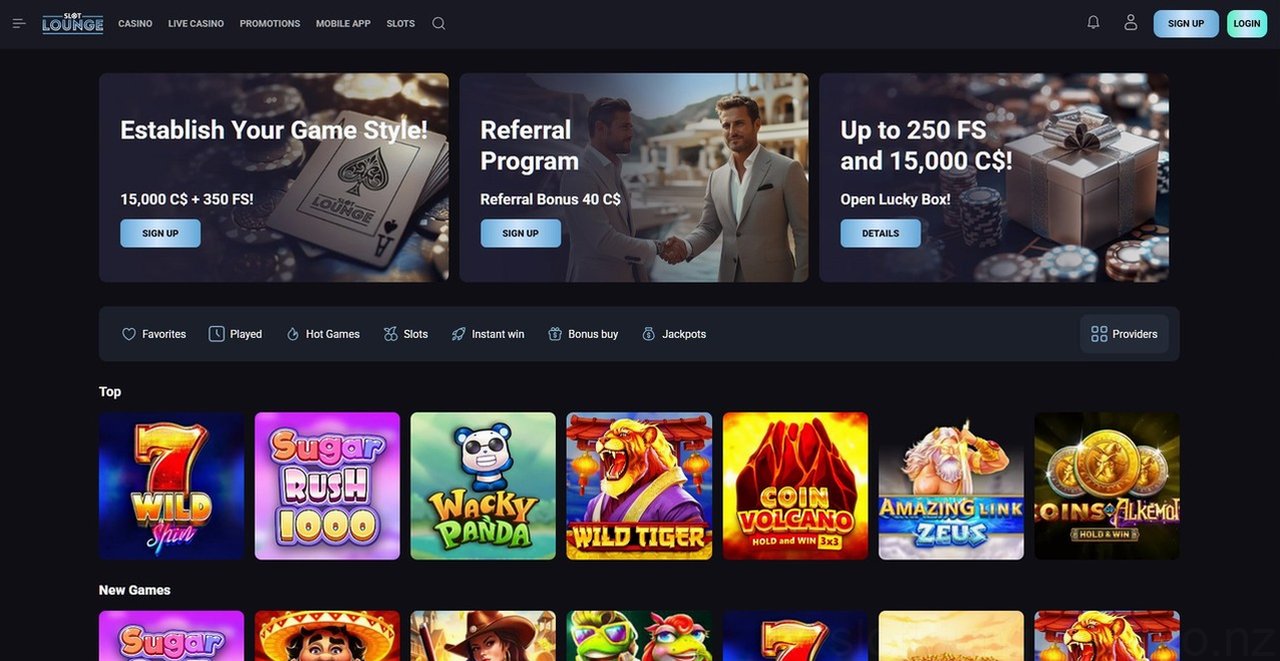
Beyond pokies, most offshore platforms also offer table games such as blackjack, roulette, and baccarat variants, along with a live dealer section streaming real-time games hosted by croupiers. It's worth noting these are casino table and live games — entirely separate from sports or racing betting, which in New Zealand remains a statutory monopoly operated exclusively by TAB NZ under its own distinct regulatory regime.
Show More Games →Typical Game Providers Found at Offshore Platforms
Reputable offshore casinos generally partner with established studios known for independently tested RNG systems and published RTP figures. Common names Kiwi players may encounter across such platforms include:
- Pragmatic Play — widely distributed pokies with published RTP ranges.
- NetEnt — long-established studio known for classic and modern pokie titles.
- Evolution Gaming — a major live dealer game provider.
- Play'n GO — known for themed pokies with varied volatility levels.
- Microgaming — one of the older studios, historically linked to progressive jackpot pokies.
Whether all of these specific studios are present at slotlounge Casino should be confirmed directly on the platform's game lobby, as libraries change over time through licensing agreements. What matters more for an informed player is checking whether each game displays its RTP percentage and whether the studio's RNG has been certified by an independent testing body such as iTech Labs or eCOGRA — these certifications are what actually substantiate a game's fairness claim, rather than the studio's brand name alone.
Bonus Offers
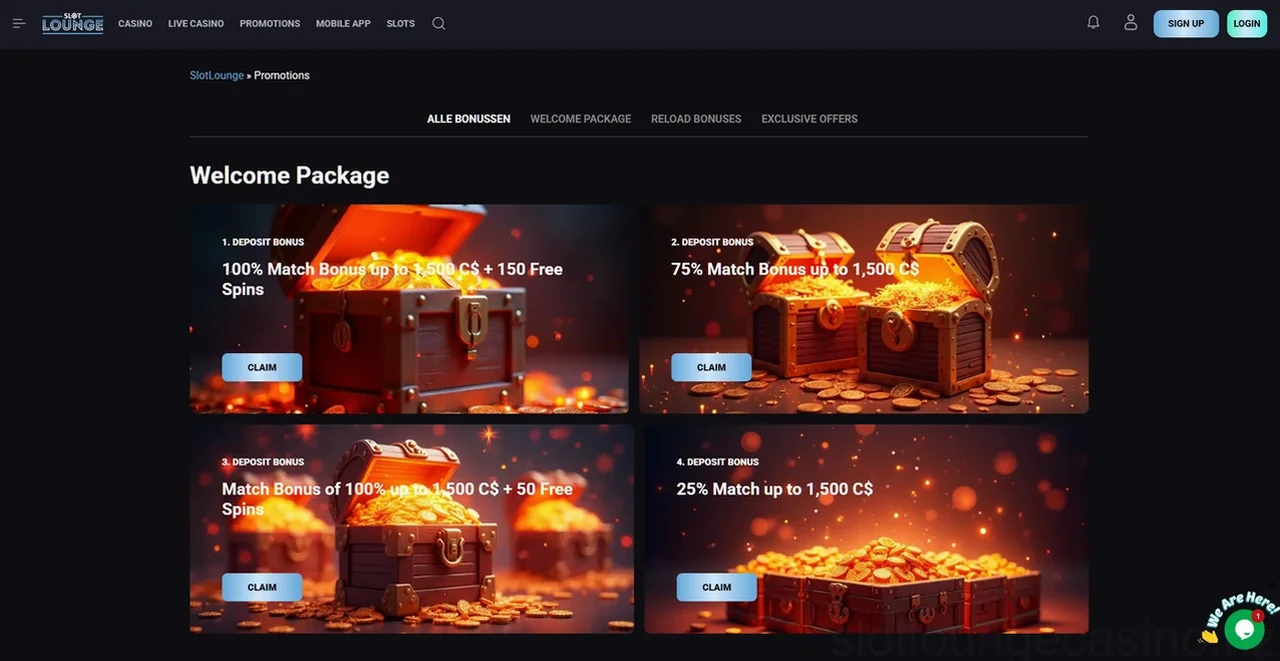
Bonus promotions are a central part of how offshore operators, including slotlounge Casino, attract new players. Typical offers include a welcome match bonus on a first deposit, free spins on selected pokies titles, and ongoing promotions such as reload bonuses or loyalty schemes. For New Zealand players, it is important to treat bonus terms as legally binding conditions rather than simple marketing flourishes — they determine whether winnings can actually be withdrawn.
The mechanics behind these offers generally follow an industry-standard structure. A deposit match bonus adds a percentage of the player's deposit as bonus funds, which must then be wagered a set number of times (the "wagering requirement") before any winnings become withdrawable. Free spins packages work similarly, crediting spins on specific pokies titles, with resulting winnings often subject to their own wagering conditions and maximum withdrawal caps.
Free Spins Package
Fixed number of spins on select pokies
Winnings capped, separate wagering
Claim Bonus →Common Bonus Terms to Review
Before claiming any bonus at slotlounge Casino or a comparable offshore site, players should look closely at several recurring terms that materially affect value:
- Wagering requirement multiplier (e.g., 35x bonus, 40x deposit + bonus).
- Maximum bet size allowed while a bonus is active — exceeding it can void winnings.
- Game contribution rates — pokies often count 100% towards wagering, while table games may count far less.
- Bonus expiry window, typically between 7 and 30 days.
- Maximum cashout cap on bonus-derived winnings.
The table below illustrates a generic comparison of the bonus structures commonly found at offshore platforms, for educational purposes rather than a guaranteed representation of any single current promotion.
| Bonus Type | Typical Structure | Key Condition |
|---|---|---|
| Welcome match | 100% up to a set NZD-equivalent cap | Wagering requirement 30-40x |
| Free spins package | Fixed number of spins on select pokies | Winnings capped, separate wagering |
| Reload bonus | Smaller percentage match on repeat deposits | Often time-limited |
| Loyalty/VIP scheme | Points-based tiers with perks | Requires ongoing wagering activity |
The main pitfall for Kiwi players is assuming a large headline percentage automatically equals good value. A 200% bonus with a 50x wagering requirement can be far harder to clear than a modest 50% bonus with a 20x requirement. Reading the full bonus terms at slotlounge Casino — not just the promotional banner — is the only reliable way to judge whether an offer suits a particular playing style and budget.
Banking
Payment flexibility is a practical concern for New Zealand players, particularly because many local banks apply restrictions or additional scrutiny to transactions linked to offshore gambling platforms. This has made e-wallets and cryptocurrency increasingly relevant options for Kiwi players wanting reliable deposit and withdrawal pathways, since these methods often route around card-specific blocks applied by NZ banks.
Offshore operators like slotlounge Casino typically support a mix of traditional and digital payment options, though exact availability can vary and should always be confirmed directly on the platform's cashier page rather than assumed from general industry patterns. Processing times, minimum withdrawal amounts, and verification requirements also differ by method.
Typical Payment Categories
Understanding the general categories of payment methods used across offshore casinos helps New Zealand players anticipate what to expect at the cashier, even before checking specifics:
| Method Type | Speed | NZD Relevance |
|---|---|---|
| Bank cards (Visa/Mastercard) | Instant deposit; withdrawals slower | May be blocked or flagged by NZ banks |
| E-wallets | Fast both ways | Useful workaround for card restrictions |
| Cryptocurrency (e.g., Bitcoin, USDT) | Near-instant, low fees | Bypasses bank involvement entirely |
| Bank transfer | Slower, 1-3+ business days | Subject to standard NZ transfer limits |
Cryptocurrency in particular has become a practical option for New Zealand players precisely because it does not rely on a domestic bank processing the transaction, reducing the chance of a declined payment. That said, crypto carries its own considerations — value volatility between deposit and withdrawal, and the need to use a reputable exchange to acquire the currency safely.
Before relying on any payment method at slotlounge Casino, players should verify a few practical points directly on the platform:
- Minimum and maximum deposit/withdrawal amounts in NZD or NZD-equivalent.
- Any processing or currency conversion fees.
- Verification (KYC) documents required before a first withdrawal is approved.
- Estimated withdrawal processing time by method.
A recurring pitfall for new players is not completing identity verification early. Waiting until the first withdrawal request to submit ID documents often delays payouts significantly — completing this step soon after registration is generally the more efficient approach.
How casino game mechanics work
Understanding the mechanics behind online pokies and table games helps New Zealand players interpret what they see on screen, rather than relying on guesswork or myths about "hot" and "cold" machines. Every certified online pokie runs on a Random Number Generator (RNG), a piece of software that produces unpredictable outcomes for each spin, independent of previous results. This means no spin is influenced by how much time has passed, how much was previously wagered, or how many spins came before it — each outcome is mathematically independent.
Return to Player (RTP) is a theoretical percentage calculated over millions of simulated rounds, indicating how much of all wagered money a game is designed to return to players over the long term. An RTP of 96%, for example, means that over a very large number of spins, the game is designed to return $96 for every $100 wagered — but this is a statistical average, not a guarantee for any individual session, which could easily finish well above or below that figure.
Volatility (sometimes called variance) describes how a pokie distributes its payouts rather than how much it pays overall. A low-volatility pokie tends to produce smaller, more frequent wins, which can suit players wanting longer, steadier sessions on a fixed budget. A high-volatility pokie produces less frequent but potentially larger wins, suiting players comfortable with more fluctuation in their bankroll. Neither type is inherently "better" — the right choice depends on a player's own risk tolerance and session goals.
Live dealer games work on a different mechanical basis entirely: instead of an RNG determining outcomes, a real dealer manages physical cards, a roulette wheel, or other equipment, streamed via video to players in real time. Fairness here depends less on RNG certification and more on regulated studio operations, camera verification systems, and the licensing body's oversight of the live studio provider. Recognising this distinction helps players understand that "fairness" is verified differently depending on whether a game is RNG-based or dealer-based, and independent testing labs typically audit each type using different methodologies.
Game Providers
Software providers we work with
The casino partners with certified game providers including Pragmatic Play, Play'n GO, and NetEnt, each audited by independent testing labs to ensure fair RNG outcomes and transparent payout verification across their game portfolios.












Customer Support
Customer support quality varies considerably across offshore operators, and it is one of the more difficult aspects for a prospective player to judge before signing up, since most support interactions only become visible once an account is active. Typical channels offered by platforms like slotlounge Casino include live chat, email support, and sometimes an FAQ or help centre covering common account and payment queries.
When evaluating support quality at any offshore casino, New Zealand players should pay attention to a few practical signals rather than assuming 24/7 availability automatically means high quality:
- Whether live chat is staffed around the clock or only during specific hours (often listed in UTC or another non-NZ timezone).
- Average response times for email queries, particularly those related to withdrawal delays.
- Whether support staff can clearly explain bonus terms and verification requirements, rather than giving generic responses.
- Availability of a dispute escalation path — for example, referral to the licensing authority's own complaints process, since no New Zealand regulator currently has jurisdiction over offshore complaints.
Because slotlounge Casino operates outside New Zealand's legal framework, any support or dispute resolution process runs entirely through the operator's own channels and its offshore licensing authority — there is no DIA complaints mechanism to fall back on until the domestic licensing regime is fully operational from 2027 onward.
Pros and Cons
Weighing the practical advantages and drawbacks of using an offshore platform like slotlounge Casino helps put the earlier sections into context. None of these points should be read as a recommendation either way — they are simply the trade-offs inherent to the current New Zealand market structure, where no domestically licensed alternative yet exists.
Pros
- Access to a broad pokies library and live dealer games not otherwise available domestically.
- Crypto and e-wallet options can bypass NZ bank restrictions on gambling transactions.
- Independent RTP/RNG certification (where present) offers a layer of game-fairness assurance.
Cons
- No New Zealand consumer protection or DIA oversight applies to offshore play.
- Dispute resolution relies entirely on the foreign licensing authority's process, which may be slower or less accessible.
- Bonus terms can be complex, and wagering requirements may reduce real-world value.
- Bank transfers linked to gambling sites may be delayed or declined by NZ banks.
Responsible Gambling
Responsible gambling should never be an afterthought, particularly given that offshore platforms like slotlounge Casino operate outside New Zealand's consumer protection framework entirely. Online casino play in New Zealand is restricted to adults aged 18 and over , and this age threshold applies regardless of which offshore jurisdiction licenses the operator.
New Zealand players struggling with gambling harm, or supporting someone who is, can contact the national Gambling Helpline free on 0800 654 655 , or text 8006 — this service is free and available seven days a week. Further information and self-assessment tools are available at safergambling.org.nz . In a genuine crisis situation, call 111 immediately.
Because slotlounge Casino is an offshore operator, New Zealand's national self-exclusion tools do not yet apply to it. It's important to understand this accurately: New Zealand's forthcoming national online self-exclusion register is mandated under the new legislation to be operational by December 2027, but it is not yet live , and it will only apply to DIA-licensed operators once the regime is fully rolled out. In the meantime, players wanting to limit or stop their play at an offshore site need to rely on tools offered directly by that operator.
Practical self-management options currently available to New Zealand players include:
- Using the casino's own account settings to set deposit limits, loss limits, or session time reminders.
- Requesting a temporary account suspension or permanent closure directly through the operator's support team.
- Installing independent software-based blockers such as Gamban or GamBlock, which restrict access to gambling sites across devices regardless of which casino is involved.
- Speaking with the national Gambling Helpline for confidential guidance and referral to local support services.
Recreational gambling in New Zealand carries no personal tax liability on winnings, but that fact should never be confused with an incentive to gamble beyond one's means. Setting a budget in advance, treating losses as the cost of entertainment rather than an investment, and taking regular breaks are all sound practices regardless of which platform a player chooses to use.
Payment Methods
Offshore operators like slotlounge Casino typically support a mix of traditional and digital payment options — bank cards (Visa/Mastercard), e-wallets, cryptocurrency (e.g., Bitcoin, USDT), and bank transfer. E-wallets and cryptocurrency are generally the most reliable for NZ players, since they reduce reliance on NZ banks. Exact availability should always be confirmed directly on the platform's cashier page.
About the Author
Last reviewed: 13 July 2026 by Liam Thompson
Frequently Asked Questions
Is slotlounge Casino licensed in New Zealand?
No. No online casino currently holds a New Zealand DIA licence, because domestic licences under the Online Casino Gambling Act 2026 are only being issued from 1 December 2026. slotlounge Casino, like all platforms currently serving Kiwi players, operates under an offshore licence, which is not New Zealand authorisation.
Is it illegal for me to play at slotlounge Casino from New Zealand?
Individual players are not committing a criminal offence by playing at an offshore casino under current New Zealand law. The 2026 Act's enforcement focus is on unlicensed operators and advertisers, not individual players. However, playing offshore means no New Zealand consumer protections apply.
What happens when DIA licences launch in December 2026?
From 1 December 2026, up to 15 operators will begin receiving DIA licences, with the regime becoming fully operational through 2027. This will create New Zealand's first domestically regulated online casino options, separate from any offshore platform's foreign licence.
Can I self-exclude from slotlounge Casino?
Yes, through the operator's own account tools such as deposit limits, temporary suspension, or account closure. New Zealand's national self-exclusion register is not yet live and won't cover offshore platforms until the domestic regime matures.
What payment methods work best for NZ players at offshore casinos?
E-wallets and cryptocurrency are generally the most reliable, since they reduce reliance on NZ banks, which sometimes flag or block card transactions linked to gambling sites.
What licence does slotlounge Casino hold?
Offshore operators typically hold licences from jurisdictions such as Malta (MGA), Curaçao, or Kahnawake (Canada). An MGA, Curaçao, or Kahnawake licence is a foreign licence and does not constitute New Zealand authorisation, regulation, or endorsement of any kind. Confirm the specific offshore authority and cross-check the licence number on that authority's public register.
How can I check a game is fair?
Look for independent game-fairness testing seals from organisations such as eCOGRA or iTech Labs, which audit random number generator (RNG) certification and return-to-player (RTP) accuracy. Every certified online pokie runs on an RNG that produces unpredictable outcomes for each spin, independent of previous results.
What is RTP and volatility?
Return to Player (RTP) is a theoretical percentage calculated over millions of simulated rounds — an RTP of 96% means the game is designed to return $96 for every $100 wagered over the long term. Volatility describes how a pokie distributes its payouts: low-volatility gives smaller, more frequent wins, while high-volatility gives less frequent but potentially larger wins.
Final Verdict
slotlounge Casino represents a fairly typical example of the offshore platforms New Zealand players currently rely on, in the absence of any domestically licensed alternative. Its pokies library, bonus structure, and payment options follow patterns common across the offshore iGaming industry, and prospective players should approach it the same way they would any offshore site: by checking the specific licence held, looking for independent RNG/RTP certification, and reading bonus terms carefully before depositing.
The broader context matters just as much as the platform itself. New Zealand's Online Casino Gambling Act 2026 is set to reshape this market meaningfully, with DIA-issued licences arriving from 1 December 2026 and a fully operational domestic regime expected through 2027. Until then, players choosing to use slotlounge Casino or any comparable offshore operator should do so with a clear understanding that no New Zealand consumer protections currently apply, and that responsible play — supported by the national Gambling Helpline and available self-management tools — remains the most important safeguard available today.